If you've ever walked barefoot across a perfectly maintained Minnesota lawn and thought — this is exactly what a lawn should feel like — you were almost certainly standing on Kentucky Bluegrass. Known to turf professionals as KBG (Poa pratensis), it's the dominant cool-season grass species across Minnesota and the upper Midwest for a reason: nothing else delivers that combination of color, texture, and cold hardiness at the same level. This is the species PeakGreen programs are built around.
What Kentucky Bluegrass Actually Is
Despite the name, Kentucky Bluegrass isn't from Kentucky — it's native to Europe, Asia, and northern Africa and arrived in North America with early settlers. It got its name from the blue-green hue of its seed heads when viewed in mass, visible on Kentucky pastures in spring. As a cool-season perennial grass, KBG thrives in the 60–75°F range — precisely the temperatures Minnesota delivers in spring and fall, which is why it performs better here than anywhere in the warm-season grass belt.
What Kentucky Bluegrass Loves
Understanding what KBG thrives in is the first step to maintaining it correctly. Minnesota's climate aligns with almost everything KBG wants — which is exactly why the species dominates here.
Cool Temperatures
KBG is at its absolute best when air temps are between 60 and 75°F and soil temps are in the 50–65°F range. This is Minnesota's spring (May) and fall (September–October) in a nutshell. During these windows, KBG produces aggressive root and shoot growth, recovers from damage quickly, and maintains its signature deep blue-green color without any stress. This natural alignment with Minnesota's shoulder seasons is what makes KBG the right grass for this climate.
Full Sun
Kentucky Bluegrass is a sun-loving species that wants a minimum of 6 hours of direct sunlight per day. In those conditions it's dense, competitive, and difficult for weeds to establish in. In full sun with proper fertilization, a KBG lawn develops the tight, carpet-like density that most homeowners picture when they imagine the perfect lawn.
Well-Drained, Fertile Soil
KBG performs best in loamy, well-drained soil with a pH between 6.0 and 7.0. It responds strongly to nitrogen fertilization — more so than most other cool-season species. The PeakGreen Proprietary Blend at 3–5.5 lbs per 1,000 sq ft is formulated specifically to deliver the slow-release nitrogen KBG responds to without the burn risk that fast-release products create.
Consistent Moisture
KBG needs approximately 1 to 1.5 inches of water per week during active growth. It doesn't like flooding or drought equally — consistent moisture at the right level is what produces even color and density. Deep, infrequent watering (1–2 times per week vs. light daily watering) trains roots to grow 4–6 inches deep, dramatically improving drought resistance.
Fall Aeration and Overseeding
KBG produces rhizomes — horizontal underground stems that spread laterally and produce new shoots. This is what gives KBG its self-repairing ability. Fall core aeration opens the soil profile and allows rhizomes to penetrate deeper and spread more aggressively. Overseeding after aeration introduces fresh genetics that improve density, disease resistance, and color over time. No other common grass species self-repairs as effectively as KBG when properly supported.
What Kentucky Bluegrass Hates
KBG has real weaknesses — understanding them is what separates the lawns that look great all season from the ones that struggle mid-summer.
Heat and Drought Stress
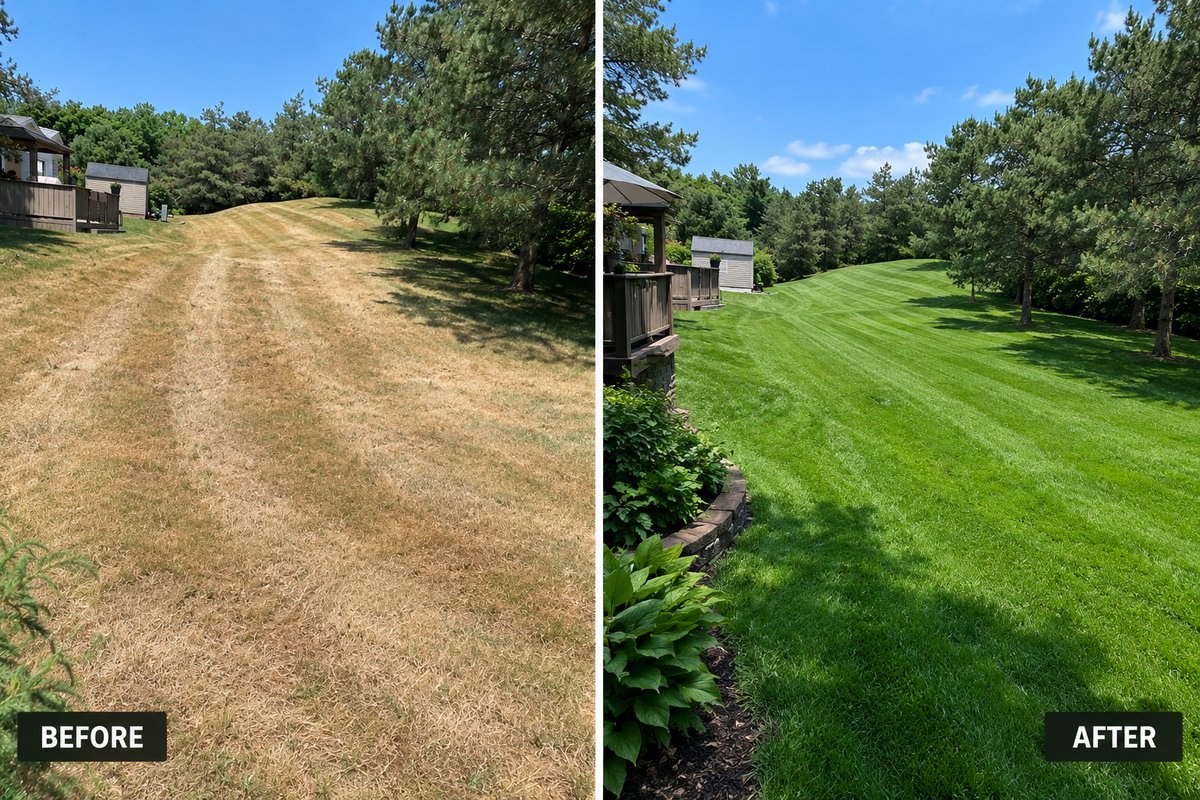
When air temps exceed 85–90°F and soil moisture drops, KBG enters summer dormancy. The lawn turns straw-colored and growth essentially stops. This is a survival mechanism, not death — KBG will green up again when temps cool and moisture returns. The mistake many Minnesota homeowners make is overwatering during dormancy trying to keep it green, which actually increases disease pressure. The right answer is to let it go dormant or maintain consistent deep watering before dormancy sets in.
Shade
Below 4 hours of direct sun per day, KBG struggles significantly. Under trees and on the north side of structures, KBG thins out, weakens, and eventually loses to shade-tolerant weeds. For shaded areas, Fine Fescue blends are a better choice — KBG should be planted where it can get the sun it needs.
Compacted Soil
KBG's rhizomes can't penetrate compacted soil. In heavily compacted areas — high traffic zones, clay-heavy subsoil, or lawns in older Minnesota neighborhoods — KBG thins and weakens from the roots up. Annual fall core aeration is not optional for maintaining KBG in Minnesota clay soils. It's the single most important cultural practice for this species in our region.
Slow Establishment
KBG is notoriously slow to establish from seed — germination takes 14 to 21 days under ideal conditions, and full establishment can take an entire growing season. For homeowners in a hurry, this is a weakness. The workaround is fall overseeding into aeration holes, which dramatically improves germination rates by providing direct seed-to-soil contact and consistent moisture retention.
Thatch Buildup
KBG's aggressive rhizome production is a strength for self-repair, but it also contributes to thatch buildup — the layer of dead organic matter between the soil surface and living grass blades. Thatch above ½ inch restricts water and nutrient penetration and creates a haven for fungal disease. Annual core aeration helps manage thatch naturally by introducing soil-dwelling microorganisms that break it down.
✓ KBG Strengths
- Exceptional cold hardiness — Zone 2
- Self-repairing via rhizomes
- Finest texture of any common MN grass
- Deep blue-green color — highest visual appeal
- Dense growth suppresses weeds naturally
- Perfect fit for Minnesota's climate
- Responds aggressively to proper fertilization
- Recovers from dormancy reliably
⚠ KBG Weaknesses
- Slow establishment from seed
- Goes dormant in summer heat
- Needs 6+ hours direct sun
- Thatch-prone without management
- Needs consistent moisture
- Susceptible to summer fungal disease
- Requires annual aeration on clay soils
- Higher maintenance than fescues
Kentucky Bluegrass vs. Other Grasses — The Barefoot Test
Here's where KBG separates itself most dramatically from other grass species commonly discussed for Minnesota and across the country. The experience of walking on a mature KBG lawn — barefoot, in the morning when the dew is still on it — is genuinely different from any other grass type. The leaf blades are fine, soft, and dense. It compresses under your feet rather than resisting. There's a reason golf courses, high-end parks, and the nicest residential lawns in Minnesota run Kentucky Bluegrass.
KBG vs. Bermudagrass
Bermudagrass is frequently cited as the toughest, most aggressive turf grass available — and for warm climates, that reputation is earned. But in Minnesota, Bermuda is a non-starter as a standalone lawn grass. It's a warm-season species that goes completely dormant — brown — the moment temperatures drop below 50°F, which in Minnesota means it's brown from October through May. That's seven months of dead-looking turf.
Beyond the climate incompatibility, Bermuda's texture is noticeably coarser than KBG. The leaf blades are stiffer, narrower, and have a slightly rough, wiry feel underfoot — especially noticeable when walking barefoot. Bermuda is built for durability and traffic tolerance, not for the soft, lush lawn experience Minnesota homeowners want when they're out in their yard on a summer evening. KBG delivers that experience. Bermuda simply doesn't.
Barefoot comparison — KBG vs. Bermuda:
Kentucky Bluegrass: Fine, dense, soft blades. Gives slightly underfoot. Cool and cushioned in the morning. The lawn you want to sit on.
Bermudagrass: Stiffer, wiry blades with slight roughness. More like a durable mat than a carpet. Built for wear, not comfort. Dormant and brown in Minnesota winters.
| Kentucky Bluegrass | Bermudagrass | Tall Fescue | |
|---|---|---|---|
| Minnesota viability | ✓ Excellent | ✗ Poor — dormant 7 months | ✓ Good |
| Barefoot feel | Soft, dense, cushioned | Stiff, wiry, rough | Coarser than KBG |
| Texture | Very fine | Medium-fine but stiff | Medium-coarse |
| Color | Deep blue-green | Medium green | Dark green |
| Self-repair | Yes — rhizomes | Yes — aggressive | No — bunch grass |
| Shade tolerance | Poor | Very poor | Moderate |
| Drought tolerance | Dormancy then recovers | Very high | High |
| Cold hardiness | Zone 2 | Zone 7 (not MN) | Zone 4–5 |
| Establishment speed | Slow — 14–21 days | Fast | Fast — 7–14 days |
| Mowing height | 2.5–3.5" | 0.5–1.5" | 3–4" |
Why PeakGreen Programs Are Built Around KBG
Every program decision PeakGreen makes — application timing, fertilizer rates, aeration scheduling — is calibrated around the specific biology of Kentucky Bluegrass in Minnesota's climate. Pre-emergent goes down when KBG's soil temp threshold aligns with crabgrass germination risk. Fertilization rates are set to support KBG's aggressive nitrogen response without causing the summer stress that excess fast-release nitrogen creates. Fall aeration is timed to KBG's natural fall root flush — the most active growth period of the entire year.
Understanding your grass species isn't just academic — it's the difference between a program that works and one that produces mediocre results. KBG is the right grass for Minnesota. Managing it right is what PeakGreen is here for.
Quick-reference: KBG care calendar for Minnesota
Late April: Pre-emergent application — timed to soil temps and forsythia bloom
May–June: First fertilization — slow-release nitrogen to support spring growth flush
June–August: Maintain 3–3.5" mow height. Deep water 1–1.5"/week. Allow summer dormancy if needed.
Late August–September: Core aeration and overseeding — most important window of the year
September–October: Fall fertilization — builds root carbohydrate reserves for winter and spring green-up
October–November: Final mow at 2.5" (when and how). Leaf cleanup before freeze.
A KBG program built for your Minnesota lawn.
PeakGreen serves Owatonna, Austin, Rochester, Faribault, Waseca, Albert Lea, and Stewartville, MN. Every program is calibrated for Kentucky Bluegrass in Minnesota's climate — not a generic national template.
Call 507-440-7823