Crabgrass treatment in Minnesota is one of the most common problems homeowners face — and one of the most mishandled. The timing window is narrow, the products have to match the growth stage, and the long-term solution requires more than just spraying once. This guide covers everything a Minnesota homeowner needs to know about treating and preventing crabgrass the right way.
What Makes Crabgrass a Minnesota Problem
Crabgrass thrives in exactly the conditions Minnesota summers deliver — warm soil, open thin turf, and plenty of sunlight. A single crabgrass plant can produce up to 150,000 seeds before dying off in fall, and those seeds overwinter in your soil and germinate the following spring. If you didn't get ahead of it this year, you'll fight twice as hard next year.
Minnesota's freeze-thaw cycle and clay-heavy soils compound the problem. Thin, compacted turf creates the bare spots crabgrass needs to establish. Dense, properly fertilized turf crowds it out — which is why fertilization and crabgrass control work together, not independently.
The Minnesota Crabgrass Treatment Calendar
Early Spring — Pre-Emergent Application (Late April)
The most important step. Apply pre-emergent herbicide when soil temperatures at 2-inch depth reach 45–50°F consistently — typically late April in southern Minnesota. This creates a chemical barrier in the soil that stops germination before it starts. Missing this window by even 7–10 days can compromise your entire season's crabgrass defense.
Late Spring — Monitor for Breakthrough (May–Early June)
Even a properly applied pre-emergent won't catch 100% of seeds. High-traffic areas, bare spots, and edges near driveways often allow breakthrough germination. Watch for the characteristic crabgrass seedling — wide leaf blades with a distinctive star pattern.
Summer — Post-Emergent Treatment (June–August)
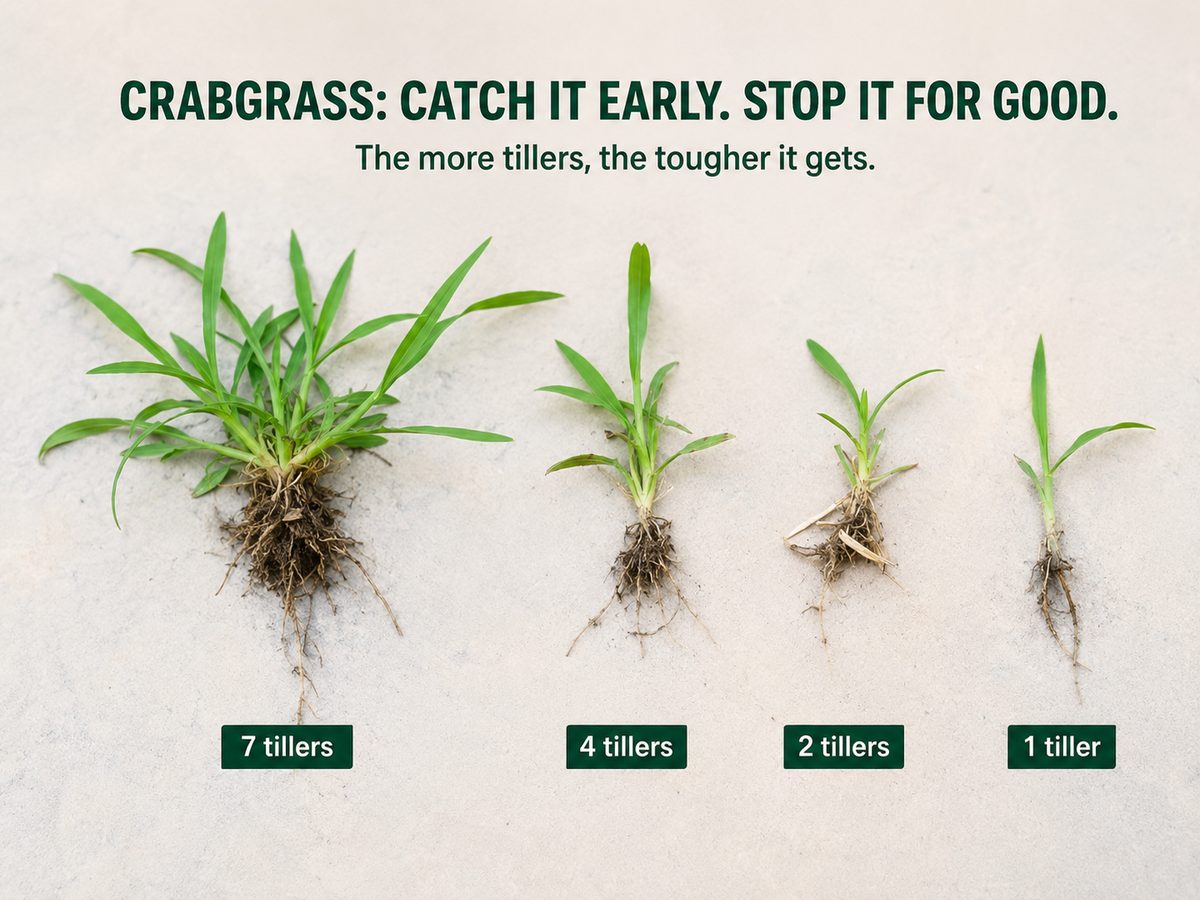
For plants that establish despite pre-emergent treatment, post-emergent herbicide applied while the crabgrass is young and under 3 tillers is your window. Once crabgrass matures past the tillering stage in late July and August, post-emergent effectiveness drops significantly. Early summer identification and treatment is critical.
Fall — Repair and Prevent (September–October)
After crabgrass dies with the first hard frost, the bare patches it leaves need to be repaired with overseeding and fall fertilization. Dense turf going into winter is your best long-term crabgrass prevention — thick grass physically blocks seeds from reaching soil contact in spring.
Pre-Emergent Crabgrass Treatment for Minnesota Lawns
Pre-emergent herbicide is your strongest tool for crabgrass treatment in Minnesota — but only if the timing is right. The key biological indicator for southern Minnesota is forsythia bloom. When forsythia shrubs are in full yellow bloom, soil temps are approaching the 50°F germination zone and it's time to apply.
Minnesota pre-emergent timing guide:
Target window: When forsythia is in full bloom — typically late April in Owatonna, Austin, Faribault, and Rochester MN
Soil temp trigger: Apply when soil temps are consistently 45–50°F at 2-inch depth
Do NOT aerate in spring after pre-emergent application — core aeration punches holes through the chemical barrier
Application rate matters as much as timing. Thin applications leave gaps in the barrier. PeakGreen applies pre-emergent as part of every program at the agronomic rate for your exact lawn size — not a ballpark bag estimate.
Post-Emergent Crabgrass Treatment in Minnesota
Once crabgrass is actively growing, you're in post-emergent territory. The rules change significantly:
- Treat young plants only — post-emergent is most effective when crabgrass has 1–3 tillers (side shoots). This means June through early July in Minnesota.
- Avoid treating in heat — applying post-emergent during a heat wave above 85°F increases the risk of turf damage. Early morning applications on cooler days produce better results.
- Multiple applications may be needed — larger or more mature crabgrass plants often require a second application 7–14 days after the first.
- Mature crabgrass in late summer — crabgrass past the tillering stage in late July and August is difficult to kill without injuring surrounding turf. At that point, the more cost-effective strategy is letting it die with frost and overseeding the bare patches in fall.
Long-Term Crabgrass Prevention for Minnesota Homeowners
The most effective long-term crabgrass strategy combines three things done consistently:
1. Annual Pre-Emergent — Every Spring Without Exception
One missed year resets the seed bank in your soil. Crabgrass seeds are viable for multiple years, so consistent annual pre-emergent is the only way to gradually reduce the pressure in your lawn.
2. Dense Turf Through Proper Fertilization
A lawn maintained at 3–3.5 inches with proper slow-release fertilization physically blocks crabgrass seeds from reaching soil contact. Thin, malnourished turf is an open invitation. Our PeakGreen Proprietary Blend at 3–5.5 lbs per 1,000 sq ft produces the turf density that suppresses crabgrass naturally.
3. Fall Aeration and Overseeding
Compacted Minnesota soil thins turf from the roots up. Annual fall core aeration combined with overseeding fills the bare spots crabgrass would otherwise occupy. This is the foundation of long-term crabgrass prevention — not a quick fix, but a system that improves every year.
The bottom line on crabgrass treatment in Minnesota:
There is no single product or single application that eliminates crabgrass permanently. The homeowners with the cleanest, crabgrass-free lawns in southern Minnesota have one thing in common — they're on an annual program that combines pre-emergent timing, proper fertilization, and fall aeration. One season at a time, the seed bank depletes and the turf wins.
Crabgrass problems in your lawn?
PeakGreen serves Owatonna, Austin, Rochester, Faribault, Waseca, Albert Lea, and Stewartville, MN. Call for a free estimate — we'll build a program around your lawn's specific crabgrass pressure.
Call 507-440-7823